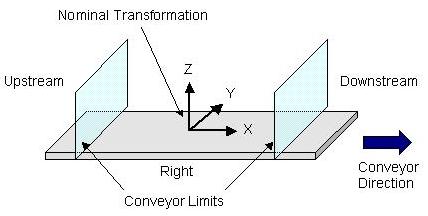
The picture below illustrates several important coordinates and positions on a conveyor belt.
Conveyor Direction -- This refers to the direction that the conveyor travels. When setting up the conveyor parameters, it is assumed that the conveyor always moves in the same direction and this initial direction is considered to be the positive direction of travel of the belt. However, when an application is executing, the belt can move in either direction and the system software will automatically adjust for the change.
Encoder Offset -- Since the raw reading of a conveyor’s encoder can increase almost without limit, an offset to the encoder reading must be set dynamically. When the conveyor encoder offset is set equal to the current reading of the encoder, the position of the encoder is effectively set to zero.
Nominal Conveyor Transformation -- The positive X-axis of this transform exactly specifies the positive direction of travel of a belt. The X and Y-axes define the plane of the belt. The X/Y/Z position of this transform defines an instantaneous (“nominal”) position of the belt. When the encoder offset is set equal to the instantaneous position of the encoder, the position and orientation of the belt is equal to the nominal transformation.
Upstream & Downstream -- “Upstream” refers to positions that are in the direction from which the belt is coming, as in swimming “upstream” against the direction of flow. “Downstream” refers to positions that are in the direction in which the belt in traveling, as in swimming “downstream” with the current. The system automatically determines the upstream and downstream directions based upon the instantaneous movement of the belt.
Conveyor Limits -- Although a conveyor can be considered to be infinite in length, there is always a finite region in which a robot can operate due to limitations in the geometry and size of the robot. On a conveyor belt, two planes that are perpendicular to the conveyor direction are specified to define this working region. When the robot is instructed to pick up a part on the belt, the system will automatically delay the start of the motion if the part is beyond the upstream limit but is moving towards the limit. If the part is already beyond the downstream limit, an error is signaled. These limits are also used when tracking the belt to signal an error and stop the robot if it moves beyond the limits.
Right and Left on the Conveyor -- “Right” and “Left” on the belt are determined by looking downstream in the direction of travel of the belt.