While the Guidance Controllers have been designed to control 3-phase brushless motors, each integrated amplifier can be individually configured to control a single phase or voice coil motor. After these types of motors are properly wired and the current loop control firmware configured, these motors can be accessed and controlled by the higher-level software in exactly the same manner as 3-phase motors.
Motor Wiring Diagram
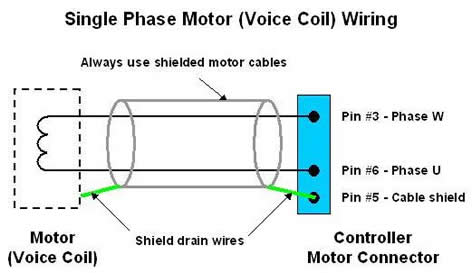
The following diagram illustrates how to wire a single phase motor or voice coil to the standard controller motor connector.
NOTE: If the motor voltage is above 48VDC and the controller is placed away from the motor, the motor wires should be looped through a ferrite core to reduce electrical noise that could adversely affect the motor encoder signals. Please see the Hardware Installation section of the Guidance Controller Hardware Manual for instructions on installing ferrite cores and information on properly sizing motor wires.
Amplifier Configuration and Current Loop Tuning
The basic function of each amplifier is to generate a motor electrical current, which produces a desired motor torque. An amplifier accomplishes this goal by reading the actual current flowing through the motor and adjusting its output commands accordingly (the "current loop"). The amplifier outputs PWM voltage signals such that the average values of the signals is equivalent to motor voltages that are predicted to generate the desired motor current.
For a 3-phase motor, the amplifier current loop is governed by two state variables, Id and Iq. The three sampled motor phase currents are converted into these two orthogonal variables. After corrective signals are generated by the current feedback loop, the Id and Iq correction signals are resolved into three PWM signals. For single phase control, the single sampled motor phase current is directly mapped into Iq and the Iq correction signal directly maps into a single output PWM signal. In this single phase mode, all of the Id signals are set to 0.
To set the amplifier current loop control into single phase mode, the following parameter must be set.
| Parameter Database ID | Parameter Name | Description |
|---|---|---|
|
10030 |
Motor commutation method |
This parameter should be set to "4" to indicate single phase output
for one or more amplifiers. Setting this value
disables the standard Vector Control, forces all Id related signals
to 0 and defines Iq to directly relate to the single phase motor current. |
After the controller has been restarted, the standard current loop tuning process should be performed. For best results, it is normally required that the output shaft of a standard motor be clamped to a fixed position during the current loop tuning.
Voice Coil PID Loop Tuning
Voice coils axes are often mechanically coupled with a spring to provide a restoring force that drives the voice coil towards a neutral position. In order to compensate for this spring force, the system includes special feedforward terms that can model both linear and non-linear spring reaction forces.
The parameters for specifying this feedforward compensation are briefly described in the following table. For more detailed information on these parameters please see the Reference Document section.
| Parameter Database ID | Parameter Name | Description |
|---|---|---|
|
10342 |
Position feedforward gain |
These parameters implement non-linear position feedforward compensation. If
the gain and other applicable parameters are non-zero, these parameters
generate a torque value that is a function of the commanded (not actual)
motor position. This term is added to the other elements of the
servo's output (e.g. acceleration feedforward, PID feedback terms, etc.) |
|
10343 |
Motor neutral position |
|
|
10344 |
Position adjustment coefficient 0 |
|
|
10345 |
Position adjustment coefficient 1 |
|
|
10346 |
Position adjustment coefficient 2 |
Aside from the special Parameter Database values described above, the configuration and operation of a single phase or voice coil motor is the same as that for a 3-phase brushless motor.