RS-485 is a multi-drop serial communication interface. At the application level, it can transmit and receive data in a manner similar to an RS-232 interface with the added benefit that the communication lines can be daisy chained between multiple nodes instead of requiring point-to-point wiring. Within GPL application programs, this port is referenced as "/dev/com4."
For reliable communications, RS-485 lines must be terminated at both ends of the daisy chain and must not have any termination at interior nodes. The RS-485 termination is controlled by a HVCPU Board Jumper. By default, this jumper is installed and the line is terminated, which means that the controller must be at one end of the RS-485 daisy chain until this jumper is removed.
The RS-485 interface is not available for interfacing to 3rd party devices when the controller is embedded in a Brooks robot such as a PreciseFlex or interfaced to a Guidance IO Module (GIO) or Guidance Slave Board (GSB). In these cases, the RS-485 supports a proprietary communication protocol that is used to interface to these Brooks devices.
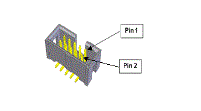
This interface is provided in a 10-pin IDC connector.
Figure 17-40: Ten-Pin IDC Connector
| Pin | Description |
|---|---|
|
1 |
24VDC. The PreciseFlex Controller can output a maximum of 2A at 24VDC on the RS-485 connector assuming that the controller's 24VDC power supply has sufficient power. |
|
2 |
|
|
3 |
GND |
|
4 |
GND |
|
5 |
GND |
|
6 |
VCC |
|
7 |
GND |
|
8 |
RS485+ |
|
9 |
RS485- |
|
10 |
GND |
|
User Plug Part No |
AMP 746285-1 or Molex 22-55-2101 or 90142-0010. For the Molex plug, use Molex pins 16-02-0103 and Molex crimp tool 63811-1000. |